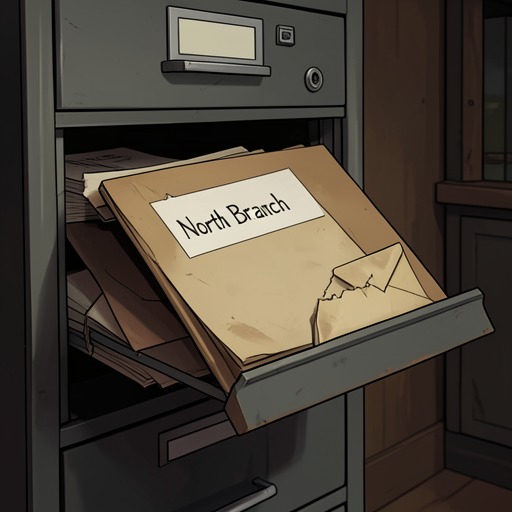
Leon Wells case file
Presumed InnocentThe Leon Wells case file is a small set of copied court papers that gives the investigation into Carolyn Polhemus’s murder a precise documentary lead. Retrieved by Dan Lipranzer in North Branch, it connects a public-indecency complaint from nine years earlier to Carolyn as Wells’s assigned probation officer and to Tommy Molto as the deputy who handled the motion dismissing the case. The papers do not resolve what lay behind that dismissal, but they make the links legible in the court record.
Recovery and Identification
Lipranzer produces four or five photocopied sheets after telling Rusty Sabich that he has been in North Branch since before five that morning. The case number is familiar: it matches the complaint number missing from the 32nd District police station. The first sheet is the case jacket for People versus Leon Wells, recording a public-indecency complaint dismissed by court order on a day in July nine years earlier. The match turns an absent complaint into a traceable court matter.
The circumstances of the discovery matter to the file’s role. Rusty has been reluctant to trust information circulating through the investigation, and Tommy Molto’s unaccounted-for status has already created political and practical uncertainty inside the office. Against that uncertainty, Lipranzer’s papers offer something specific: a case number, a named defendant, and documents whose details can be checked against the court’s own records.
What the Papers Record
The bond order identifies Carolyn Polhemus as Wells’s assigned probation officer and gives her telephone number. Under the procedure described in the record, a defendant in a minor case could satisfy bail with a signed promise to pay a sum below $5,000 if he failed to appear. The conditions were that he commit no further crimes and report by telephone once each week to a member of the court’s probation department. Carolyn’s name therefore appears not as a passing reference but as the official assigned point of contact for Wells during the case.
The final sheet is a court half-sheet for a motion to dismiss without prejudice. The form identifies the prosecutor presenting the motion as Raymond Horgan, Kindle County Prosecuting Attorney, while leaving a blank for the deputy handling the matter. Rusty initially cannot make out the signature; then he recognizes it as Tommy Molto’s. The file thus places Molto’s name on the dismissal paperwork and ties his work to a case in which Carolyn had an official role.
Investigative Significance and Limits
The papers make the old Wells complaint newly relevant because they join three otherwise distinct details: the complaint number missing from the police station, Carolyn’s assignment as probation officer, and Molto’s signature on the dismissal motion. Rusty’s immediate recognition of the signature marks the discovery as a shift in the investigation, but he cautions Lipranzer that the documents do not yet establish what happened or what the connection means. Their evidentiary force lies in the documented overlap, not in a complete explanation of it.
The case file also exposes how much depends on ordinary administrative records. Branch courts handle initial appearances, bail decisions, misdemeanor trials, and preliminary hearings in felony cases; a deputy prosecutor’s work can pass through these routine proceedings before the larger consequences become visible. Here, the bond order and half-sheet preserve details that the missing complaint alone could not supply. At the same time, the dismissal is recorded as a motion without prejudice, not as proof of an improper bargain. The file raises questions by making the procedural history recoverable, while stopping short of answering them.
Records, Custody, and Institutional Context
The file’s clear identifying trail stands in contrast to the disorder surrounding other evidence in the murder investigation. The police department’s single computer is controlled by another section, and informal loyalties shape how information is shared; elsewhere, a returned laboratory receipt for Carolyn’s bar glass is signed without the glass being restored to evidence storage. Those episodes do not alter what the Wells papers say, but they frame the conditions under which records and physical evidence can become consequential—and how easily an official process can leave gaps.
Lipranzer and Rusty examine the copies together beneath the street lamps as a band inside resumes playing “When Irish Eyes Are Smiling.” The juxtaposition does not settle the case; it places a quiet documentary discovery beside the public drama of Raymond Horgan’s electoral defeat. In that moment, the Leon Wells case file is both a clue and a boundary: it establishes who was assigned to the old case and who signed its dismissal motion, but the larger meaning of those facts remains to be pursued.